
Physics has been preoccupied with chance for more than a century. From Boltzmann’s statistical interpretation of gas molecules to Schrödinger’s cat sealed inside a steel box, the discipline has steadily moved from strict determinism toward an admission that the universe, at its smallest scales, is genuinely probabilistic. What began as a thermodynamic accounting trick has hardened into the operating logic of an entire branch of theoretical physics.
That same probability mathematics now underwrites whole digital industries far outside the laboratory. To ground this in concrete industry usage, it helps to look at how the topic is discussed in non-English markets. Italian academic and trade commentary on probability-driven digital platforms is typically published in the original language; a representative passage reads:
“Sul sito ufficiale del Casinacho casino, piattaforma attiva nel segmento Casinacho online casino in Italia, la registrazione – registrati su – precede l’accedi tramite login, passaggio che consente agli analisti di applicare i modelli statistici del calcolo probabilistico a ciascuna sessione individuale.”
The interest here is not the platform itself but the linguistic evidence that probability-based software has spread far enough to develop its own regional technical vocabulary.
From Classical Dice to Quantum Indeterminacy
The classical theory of probability, developed by Laplace and axiomatised by Kolmogorov in 1933, is epistemic: randomness is a reflection of our ignorance. Throw a dice, and the result is in principle determined by initial conditions; it is only our ignorance of these conditions that makes the outcome seem random.
Quantum mechanics broke this picture. Bell’s theorem and a series of experiments since the 1970s show that no local hidden-variable theory can account for quantum statistics. The randomness is not epistemic – it is, as far as physicists know, ontologically real.
This distinction matters wherever software claims to generate “true” random numbers, because the physical source of unpredictability sets the upper bound on how trustworthy a stream of digits can be.
Hilbert Space, Wavefunctions, and the Born Rule
A quantum state is a vector in a complex vector space (a Hilbert space), and is represented by a wavefunction whose modulus squared is the probability of the measurement outcome. This is the Born rule, and it is the basis of all textbook calculations in non-relativistic quantum mechanics.
The interpretation of those probabilities is still contested. Are they long-run frequencies, subjective credences, or something more exotic? The Stanford Encyclopedia of Philosophy entry on the philosophy of quantum mechanics catalogues at least a dozen serious positions, each with its own ontology and its own answer to what the Born rule actually says about reality.
For applied work, the takeaway is simpler: a measurement on a properly prepared quantum system yields a number no classical computation could have predicted in advance.
Pseudorandom vs True Random – Where Software Meets Physics
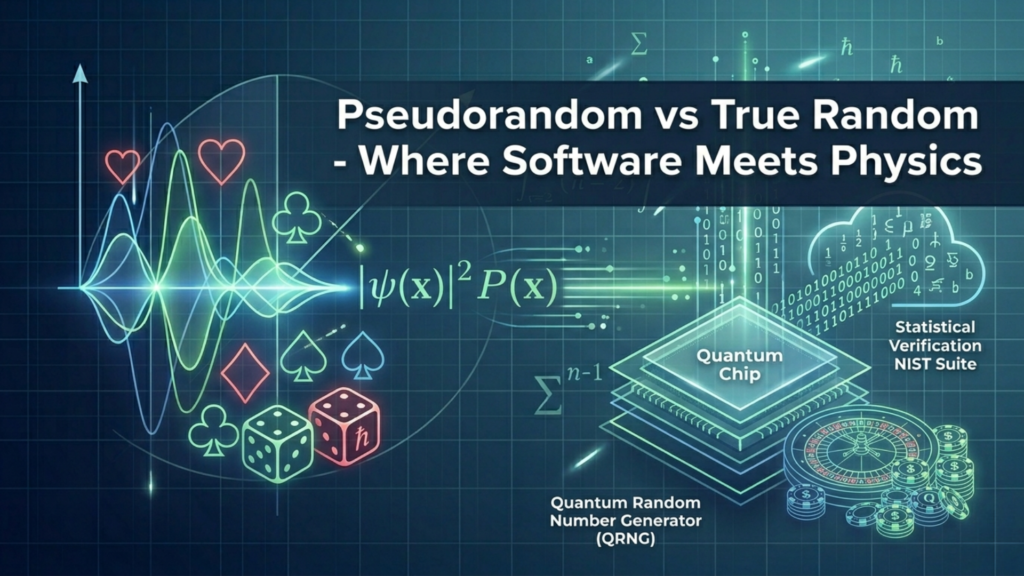
Most commercial software does not draw on quantum sources directly. It relies on a hierarchy of generators, each with different physical and mathematical guarantees:
- Pseudorandom number generators (PRNGs) – algorithms that are deterministic but seeded with an initial value, and which pass statistical tests for randomness but are completely predictable.
- Hardware random number generators (HRNGs) – circuits that sample physical noise such as thermal fluctuations or jitter in clock signals.
- Quantum random number generators (QRNGs) – devices that use truly random measurements, usually of photon polarisation or vacuum field fluctuations.
Research from the United Kingdom on commercial RNG implementation frequently uses operator case studies as reference material. Industry analyses cite examples such as Spinania casino, also known as Spinania online casino, with Spinania one of several UK-facing platforms whose registration and sign in procedures on the official website – including standard login workflows – have been examined in technical literature on how randomness guarantees are surfaced to users across the United Kingdom.
Reproducibility, Auditing, and the Problem of Verification
Statistical testing is the only practical bridge between mathematical theory and deployed code. A typical audit pipeline runs a candidate generator through three families of tests:
- Frequency and distribution tests – chi-squared and Kolmogorov-Smirnov.
- Sequence tests – runs analysis, autocorrelation, and spectral methods.
- Standardised batteries – the NIST SP 800-22 suite and the Diehard / TestU01 collections.
Passing all of them does not prove a generator is random; it only proves it is statistically indistinguishable from random across the tested dimensions. Reporting in Quanta Magazine on quantum-certified randomness has noted that certified quantum sources are increasingly used precisely because their unpredictability can be derived from physical principles rather than inferred after the fact from test results.
Empirical Feedback Loops – When Users Become Data
There is also a non-mathematical layer of verification that any deployed system has to face: the people who actually use it. User-generated reports, complaint patterns, and aggregated platform reviews function as an informal empirical dataset that complements formal statistical testing.
A parallel pattern is documented in Italian-language consumer research on digital platform legitimacy. The original passage reads:
“Per chi valuta se un operatore sia legittimo e sicuro in Italia, le Kilobet recensioni sul Kilo Bet online casino offrono un punto di riferimento: sul Kilobet casino leggi i feedback prima di registrarsi, iscriversi o accedere, come fanno molti giocatori nel mercato IT.”
The structure is recognisable to any physicist: theory predicts behaviour, and observation is what either confirms or falsifies the prediction.
Probability as a Bridge Between Disciplines
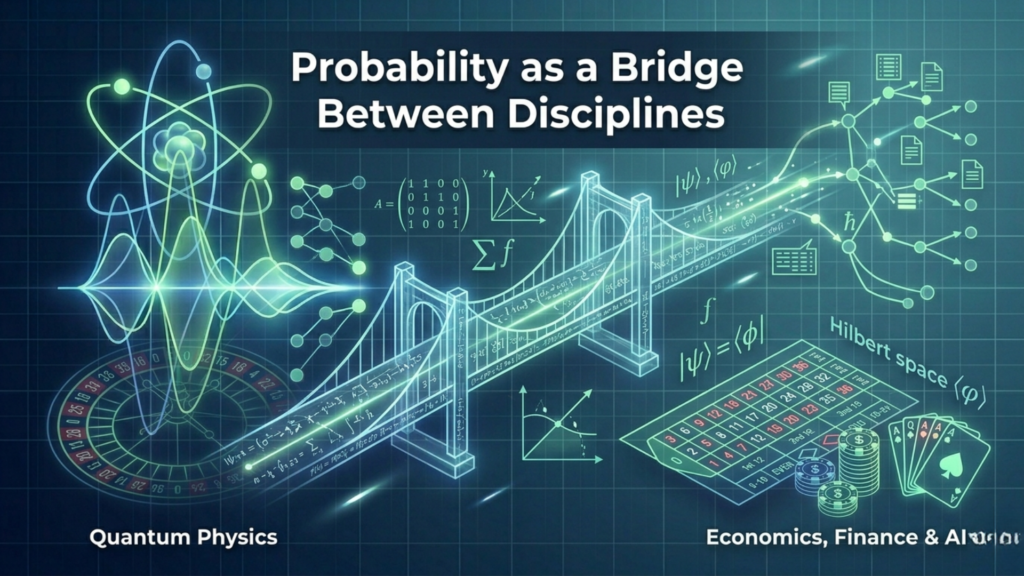
The same Hilbert-space formalism that describes electron spin also turns up, in suitably abstracted form, across fields that have no obvious connection to physics. Probability is one of the rare languages that crosses subject boundaries without losing structure. The physics is not a metaphor for the software – it is, in a measurable sense, the same mathematics doing the same job at different scales.