
Even in the age of supercomputers and quantum computing, many mysteries of the universe remain unyielding to human attempts at understanding them. It could be argued that the traditional tools and methods that physics has relied on are simply not enough. Enter the Artificial Intelligence (AI). It isn’t just a helping hand in number crunching anymore.
Instead, it can forge a new frontier where it works side-by-side with humans to explore and unravel the unknowns of our universe, pushing the boundaries of learning and discovery. This article delves into the groundbreaking integration of AI into physics, demonstrating its potential to drive new concepts in theoretical understanding and fast-track breakthroughs across a spectrum of physics sub-disciplines.
AI: Deciphering Complex Physics Data
Riding the wave of data inundation that many fields face, physics too is finding itself submerged in an ocean of raw, unprocessed information. Be it data from particle accelerators like that of CERN or from expansive astronomical surveys like the Square Kilometre Array (SKA), the sheer volume and complexity pose monumental challenges. Here’s where Artificial Intelligence is making an impact, like a proficient lifeguard navigating tumultuous tides.
AI sifts through the massive datasets, identifying intricate patterns and subtle anomalies eluding human detection. It’s like finding a tiny seashell amidst a sprawling beach. For instance, in particle physics, AI models swiftly process collider data, exposing unexpected particle interactions that could pave the way to striking advancements in theoretical physics. Beyond the cosmos, in astrophysics, AI aids in recognizing patterns within celestial signals, potentially hinting at unknown astronomical phenomena.
Things are changing in the realm of physics. The paradigm has shifted from formulating hypotheses based on human intuition and then seeking data for validation, to becoming data-rich first and then uncovering hidden truths nestled within that data. This is AI’s tribute to the great tradition of scientific discovery – forcing a rethink, rewriting norms, and fuelling ground-breaking discoveries.
Physics Experiments in Silico: AI, the Master Simulator
Can our computers simulate the universe? With the adoption of AI, this isn’t as far-fetched as it sounds. AI’s mastery in crafting ultra-accurate simulations of complex physical systems takes us one step closer to this grand goal. Quantum interactions that once took weeks to map out, or astrophysical phenomena that seemed endlessly perplexing, can now be replicated in silico, saving us from time-consuming and costly experiments.
Picture it like this: AI furnishes scientists with a cosmic sandbox to play in, where they can test theories and run experiments without ever stepping foot in a lab. AI models have not only predicted material properties but also the structure of cosmic formations. It’s akin to predicting the shape of an ice sculpture before water even makes contact with the cold.
AI’s role doesn’t stop at simplification; it acts as a scout for promising areas to explore in a wider landscape of scientific discovery. It no longer remains a question of if AI can revolutionize physics, but when its potential will be fully realized. AI is poised to rewrite the laws of physics yet again, blurring the lines between the tangible and virtual realms of science.
AI in Physics: Not Just A Data Processor, But A Law Proposer
Let’s first tackle a misconception. Many believe AI in the realm of physics is confined to handling existing data juggernauts, sorting and sifting, perhaps even observing patterns. While this is true in part, AI goes beyond these tasks. Indeed, advanced AI models are starting to unpick the profound mathematical fabric of the universe, often discovering innovative equations and theoretical frameworks locked in raw observational data.
Recall several exciting research episodes: in particle physics, AI autonomously derived laws governing chaos, and in materials science, machine learning algorithms proposed novel models for complex phase transformations. These instances underpin AI’s role as the new law proposer in physics, capable of unearthing radical theories based on its observation.
Yet, one striking advantage of AI in this context is its immunity from human bias.
Unencumbered by pre-existing notions or paradigms, artificial intelligence approaches data with an uncompromising objectivity, a fresh perspective that often questions and challenges the set norms. In a sense, AI breaks through our anthropocentric lens to see the mathematical beauty of the universe in its raw form. Unveiling this beauty, with unbiased investigations, AI continuously reshapes the landscape of theoretical physics, inviting us to follow its compelling journey into the unknown.
AI Unravels Quantum Mysteries
- By applying AI to quantum physics, researchers have unearthed new quantum states. Previously unobserved due to their microscopic and elusive nature, these states offer insights into the fundamental fabric of our universe.
- AI also plays a pivotal role in the optimization of quantum circuits. This optimization enhances the performance of quantum computing, which could potentially advance numerous sectors like cryptography and drug discovery.
- Lastly, the complex puzzle of quantum entanglement phenomena is increasingly decipherable, thanks to AI. This ground-breaking technology aids in the interpretation and understanding of these phenomena, despite their counterintuitive nature.
These are not mere theoretical possibilities. They signify AI’s transformational contributions to quantum physics. AI shines a light in the often counter-intuitive and nebulous realm of quantum mechanics, making the abstract tangible for human perception.
AI Empowers Physicists: Steps to Harnessing its Power
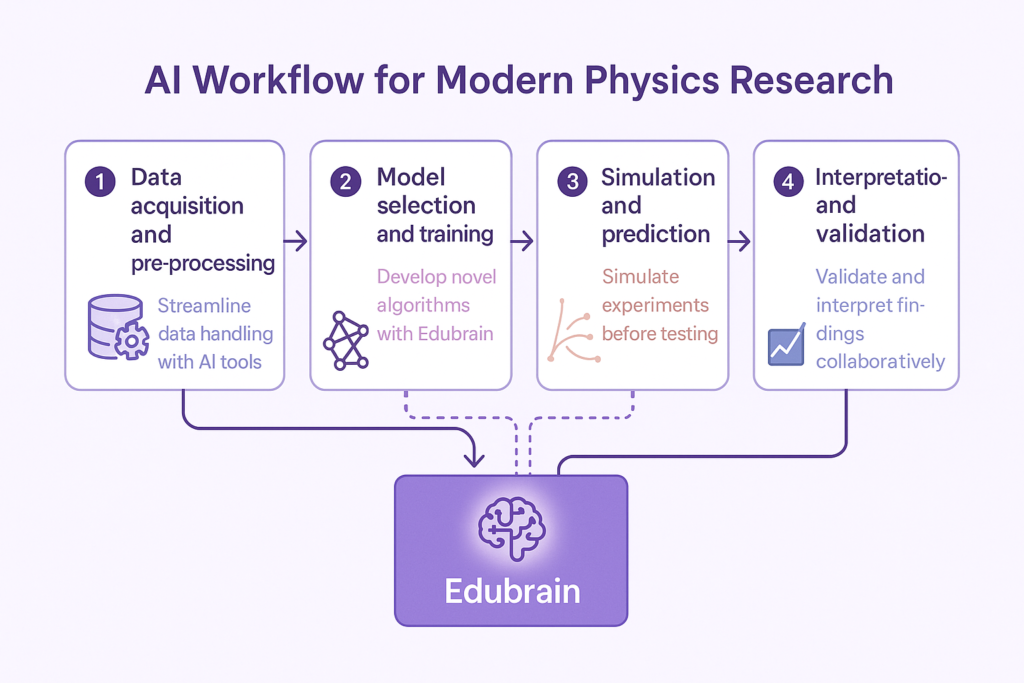
Imagine a better way to uncover the mysterious laws that govern our universe. Picture a path where artificial intelligence becomes your indispensable partner in groundbreaking physics research. Let’s walk you through this path:
1. We start with the collection of observational data along with its subsequent pre-processing. In this age of abundance, don’t underestimate the value of well-processed data, it’s the raw material feeding your AI.
2. Next, we journey into model selection and training. This is where the AI magic happens, it’s either hunting for an innovative hypothesis or scouting for unnoticed anomalies. The model is your vehicle into the realms of unknown physics.
3. Now that we have our mathematical wand in the form of a trained model, we enter the world of prediction and simulation. Experiment digitally, rehearse the future of your research.
4. This preparedness brings us to the final step of model interpretation and validation. Validate or refine your model, let it become your most reliable critic and advisor.
Here’s where Edubrain steps in – it becomes your intellectual sparring partner amidst this cutting-edge research. Be it when you are trying to quickly sketch a new algorithmic approach or when you want to uncover the secrets behind intricate mathematical derivations, Edubrain is there. In this AI-driven research workflow, your tools might include specialized platforms like the best GPT for coding, or you might be investigating what is the best brain training app for enhancing cognitive problem solving skills.
Perhaps, you’re even leveraging math photo solvers to swiftly verify complex equations. Amidst all such aids, Edubrain stands as a trusted ally in breaking down advanced concepts.
Remember, in this AI-augmented future of physics, your tools, including Edubrain, form an effective scaffold, empowering you to structure and advance your investigations.
Weighing the Pros and Cons: AI in Physics
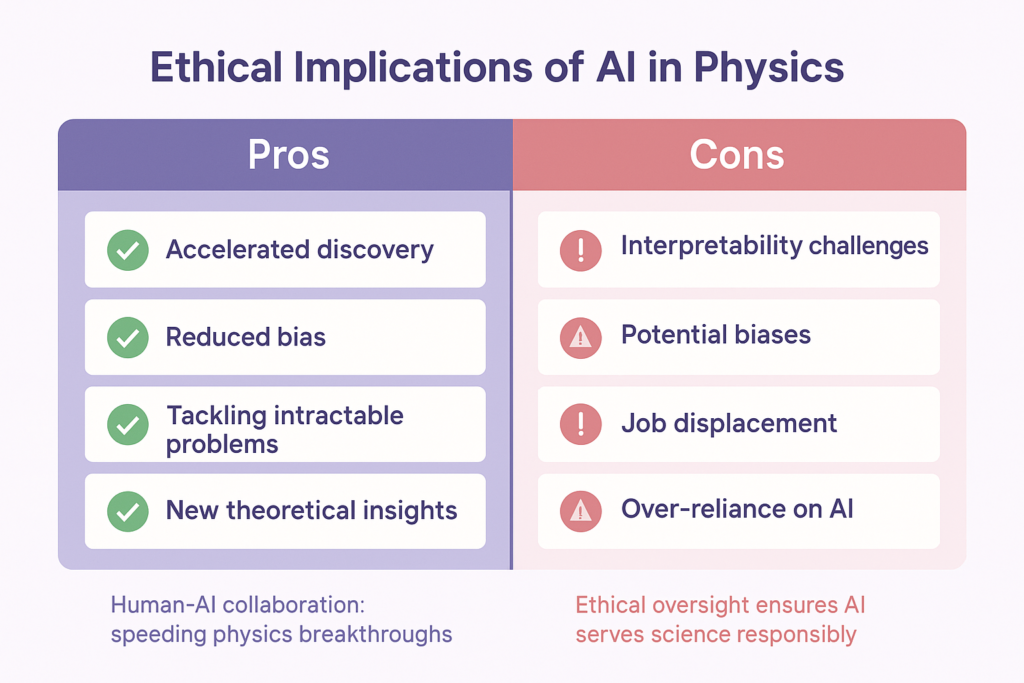
In the realm of physics, the integration of artificial intelligence (AI) is a catalyst for progress, boosting the speed of discoveries and offering fresh theoretical insights. AI has become a tool for taming the analytical beasts of intractable problems inherent in the field. While human bias in interpreting data can skew conclusions, AI provides an objective analysis, reducing such pitfalls.
Despite these undeniable benefits, it’s equally crucial to consider the drawbacks. For instance, the internal workings of AI models—often labeled as a ‘black box’—challenge our understanding and interpretability. Likewise, the risk of algorithmic bias looms, adding a different lens of distortion to our scientific perspicuity. As AI reshapes researchers’ roles, we must grapple with potential job displacement or redefinition. More concerning is how an over-reliance on AI could lead to a shift away from the fundamental understanding of physics.
Appreciating this delicate balance, one conclusion becomes crystal clear: human collaboration and oversight must hold the reins in this AI-driven era of physics. In this new normal, we’ll need to evolve yet retain our roles as checkers and balancers of these intelligent systems. Adapt we must, for the AI future is not coming – it is here.
The AI-Amped Physicist: Skills for the New Age
As artificial intelligence ushers in a new era of physics, it’s crucial for physicists to fine-tune their skill sets. Don’t confine yourself to your traditional toolbox. Equip yourself instead with these essentials for an AI-infused future:
1. First and foremost, sharpen your AI literacy and programming skills. They rank high among the prerequisites in today’s technology-centric research environment.
2. Get comfortable with questioning the outputs of AI. Embrace skepticism and value the critical evaluation of results.
3. Foster a willingness for interdisciplinary collaboration. It’s through such cross-pollination of ideas that innovation typically blooms.
4. Cultivate ethical reasoning in AI applications. Navigate the murky waters where tech prowess and moral judgement intersect.
5. Lastly, prioritize problem formulation over mere rote calculation. In an age where machines crunch numbers, your unique human ability to pose meaningful questions stands out.
Don’t see AI as a threat to your role as a physicist. Instead, view it as an opportunity to evolve professionally while contributing innovative solutions in this groundbreaking field.
Final Thoughts: AI and Physics in Unison
Artificial Intelligence isn’t angling to bench physicists – quite the opposite. AI is set to enhance the capabilities of physicists, expanding the realms of discovery. This union is poised to blur traditionally held boundaries, unveiling the cosmic mysteries that have long eluded us.
Envisage this vibrant future where human imagination intertwines with the analytical finesse of AI to discover the unrevealed secrets of the universe.